

STUDY OVERVIEW
COVID Digest
Curious what COVID has to do with the gastrointestinal (GI) system? So are we! Developing new or worsening chronic GI symptoms or conditions after infections like the flu or foodborne illness is actually not new - in fact, our study leaders have been researching this connection for several years.
Toilet paper may have been hard to find in early COVID days, but ironically, preliminary data at the time suggested the virus mainly affected the respiratory system. As more research emerged, though, reports of GI symptoms during COVID infection started piling up and we saw the same pattern in our own data, with about 30% of CoVHORT participants reporting GI symptoms during their infection. Given our team's existing research into GI symptoms after infection, we wondered whether COVID might fit that same pattern, and whether those symptoms could stick around long after the initial infection cleared.
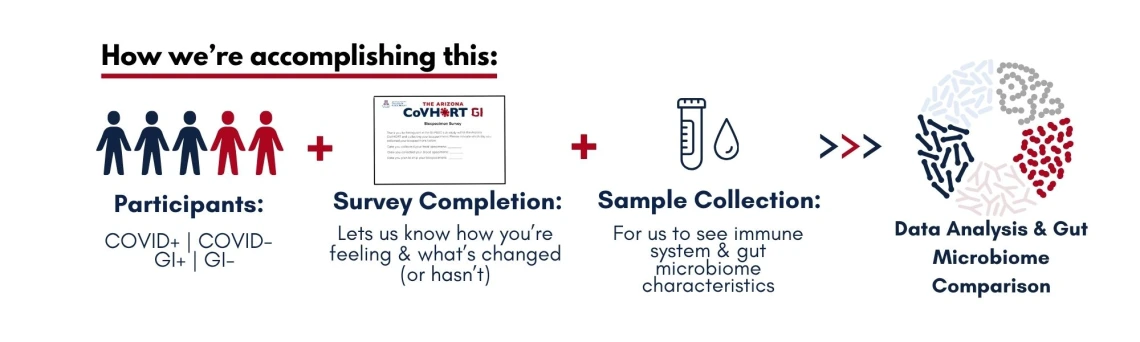
This research study compares people who have and haven't had COVID-19. We're looking at whether COVID-19 is linked to new or ongoing gut conditions, especially irritable bowel syndrome (IBS), and how infection may affect the gut microbiome
Check out our study progress here!
A Letter from our Principal Investigators
This study is the result of almost 10 years of work and collaboration between us. We all have our scientific roots in foodborne illnesses (mostly Campylobacter which you may not have heard of but may have unfortunately experienced). Before the pandemic, we were focused on the chronic effects of these infections. Through CoVHORT, we determined that there were increases in GI symptoms both during the initial COVID infection AND months later.
CoVHORT-GI pulls together epidemiology data (demographics, symptoms, health history) with microbiology & immunology data (microbiome profiles, immune response to your own gut microbes) to look at questions around risk factors for gut conditions after COVID-19 and how and why symptoms may develop. We get REALLY excited about this stuff!
Professors Kristen, Kerry & Erika
Meet the PIs!

Dr. Pogreba-Brown
Kristen Pogreba-Brown
Associate Professor
Department of Epidemiology and Biostatistics
Mel and Enid Zuckerman College of Public Health
The University of Arizona

Dr. Cooper
Kerry Cooper
Associate Professor
School of Animal and Comparative Biomedical Sciences
College of Agriculture, Life, and Environmental Sciences
The University of Arizona

Dr. Austhof
Erika Austhof
Assistant Research Professor
Department of Epidemiology and Biostatistics
Mel and Enid Zuckerman College of Public Health
The University of Arizona
Heads up: We're still enrolling!
Help us find evidence-based answers while learning more about gut health.
psst: no GI symptoms? no COVID history? no problem!
All Arizona residents 18+ are eligible to join.
Benefits of joining:
Antibody testing*
Learn about your gut microbiome*
Contribute to science
Participants can earn up to $160 for their time
Note: all CoVHORT GI participants are first enrolled in our parent study, the Arizona CoVHORT
(be sure to select 'I want to be informed of other studies' on the consent form!)
*participants meeting certain eligibility criteria will be asked to provide biospecimen samples to be collected at home if willing

What to expect when you're participating
- You'll first be enrolled into our parent study, The Arizona CoVHORT
(this mostly due to logistics - our key surveys are tied to our parent project) - While completing the study consent form, you'll be asked if you'd like to be informed of other studies to join - say yes here!
(this is how we enroll you into the GI study) - You'll then be enrolled into our sub-study, CoVHORT GI
- As a participant, we'll ask you to complete CoVHORT surveys to check in + short 10-15 minute additional CoVHORT GI-specific surveys
- If you meet certain criteria for our study groups, we'll ask you to provide blood + stool samples to help investigate how COVID may or may not impact the GI system
psst: all materials are provided and samples are collected completely at home - Once we have enough samples collected, we run complex testing and can share results, like your individual microbiome composition
CoVHORT GI Participant Flowchart

Meet the team!

Epidemiology Team
Dr. Xiaoxiao Sun
Associate Professor
Department of Epidemiology and Biostatistics
Mel and Enid Zuckerman College of Public Health
The University of Arizona

Epidemiology Team
Caitlyn McFadden
Research Program Administration Officer | Doctoral Candidate
Department of Epidemiology and Biostatistics
Mel and Enid Zuckerman College of Public Health
The University of Arizona

Epidemiology Team
Chidera Ejike
Clinical Research Coordinator | Doctoral Student
Department of Epidemiology and Biostatistics
Mel and Enid Zuckerman College of Public Health
The University of Arizona

Epidemiology Team
Gayatri Arani
Graduate Research Associate | Doctoral Candidate
Department of Epidemiology and Biostatistics
Mel and Enid Zuckerman College of Public Health
The University of Arizona

Microbiology Team
Caroline Scranton
Graduate Research Associate | Doctoral Candidate
School of Animal and Comparative Biomedical Sciences
College of Agriculture, Life, and Environmental Sciences
The University of Arizona

Microbiology Team
Dominic Rodriguez
Graduate Research Assistant | Doctoral Student
School of Animal and Comparative Biomedical Sciences
College of Agriculture, Life, and Environmental Sciences
The University of Arizona

Microbiology Team
Ella Van Wiel
Undergraduate Student
School of Animal and Comparative Biomedical Sciences
College of Agriculture, Life, and Environmental Sciences
The University of Arizona

Microbiology Team
McKinley Pasiakos
Undergraduate Student
School of Animal and Comparative Biomedical Sciences
College of Agriculture, Life, and Environmental Sciences
The University of Arizona
Check out our recent publications!
Want more information? Let’s chat!
CoVHORT-GI@arizona.edu | (520) 626 - 1678
An Institutional Review Board responsible for human subjects research at The University of Arizona
reviewed this research project and found it to be acceptable, according to applicable state and federal
regulations and University policies designed to protect the rights and welfare of participants in research.